OUR MISSION
The African American Dance Ensemble seeks to preserve
and share the finest traditions of African and African American dance
and music through research, education and entertainment. With our
motto, "peace, love, respect for everybody," we celebrate
traditional African culture, aesthetics and values as resources for
all people and utilize these resources to encourage interracial cooperation,
cross-cultural understanding and societal analysis.
ORIGINS OF THE AFRICAN AMERICAN DANCE ENSEMBLE
The Early Years
The story of the African American Dance Ensemble begins with Chuck
Davis, a native of Raleigh, North Carolina, whose path from Raleigh's
all black Ligon High School through Howard University's Theater and
Dance Program eventually led him to New York City and the world of
professional dance.
Chuck's first job as a regular member of a professional troupe came
in 1959 when he joined the Klara Harrington Dance Company. From that
point through 1968 he danced professionally with a number of modern,
jazz, Afro-Cuban and African companies. Among these are the Olatunji
Dance Company, the Eleo Pomare Dance Company, and the Bernice Johnson
Dance Company. These were learning years and Chuck learned from the
best. The list of mentors is long and impressive. Thelma Hill, Eleo
Pomare, Jean Leon Destine, Katherine Dunham and Pearl Primus are among
those who make the connections between African and Western experiences.
The African Connection
Chuck Davis' connection to Africa began with his birthright, but the
artistic connection began with a performance of the Sierra Leone National
Dance Company at the New York World's Fair in 1964. Study in Africa
became a goal. The opportunity came in 1977 when the Chuck Davis Dance
Company participated in FESTAC, an international exposition and celebration
of African culture, held in Lagos, Nigeria. Each year thereafter,
he has returned to the continent for further study of traditional
dance styles and music.
The Chuck Davis Dance Company
In 1968, the Chuck Davis Dance Company was founded in New York City
with Chuck Davis as the Artistic Director. The company performed to
rave reviews in the New York area and elsewhere in the United States,
gradually establishing itself as one of the nation's premier Afro-American
dance companies. This was the company that came to Durham, North Carolina
in 1980 at the invitation of the American Dance Festival. It was a
case of "love at first sight." There was no letting go.
Chuck Davis, the American Dance Festival, and the local community
have generated a synergy larger than any of them alone could have
achieved. Stages and auditoriums could not contain the performances.
The environment became the stage, and the audiences became the performers.
"Peace, love, respect for everybody," became the simple
but powerful message the art was bringing to the community.
The African American Dance Ensemble
Each season from 1980 to 1984 the Chuck Davis
Dance Company was in residence with the American Dance Festival's
Community Services Program and each season the participants in this
outreach program grew. By 1983 it had become obvious that there was
a developing core of local dancers whose levels of proficiency were
approaching those of the professionals from whom they were learning.
The African American Dance Ensemble was born. The Ensemble's "arrival"
came in February 1984 when they gave their first full concert as an
independent professional company. In the 1985 season of the American
Dance Festival, the African American Dance Ensemble stood on its own
and took its place among the other established companies when it premiered
two new Chuck Davis works, "Saturday Night, Sunday Morning,"
and "Drought," both of which were commissioned by the American
Dance Festival.
The Ensemble is comprised nine musicians and dancers
under the leadership of Artistic Director, Chuck Davis, a Musical
Director; a twelve member working Board of Directors, committed to
the further development of the Ensemble; and an administrative staff
of four professionals. The organization has constituted itself as
a nonprofit corporation.
Its mission is to preserve and share the finest
traditions of African and African American dance and music through
research, education and entertainment. With the motto, "Peace,
love, respect for everybody," the Ensemble celebrates traditional
African culture, aesthetics and values as resources to encourage interracial
cooperation, cross-cultural understanding and societal analysis.
The Art. . . The Work
"Peace, love, respect for everybody," is much more than
a catchy way to end a concert and the African American Dance Ensemble
is much more than just another dance troupe. The Ensemble is an agency
of positive social change and reinforcement of the best of human values
(peace, love and respect). A concert by the African American Dance
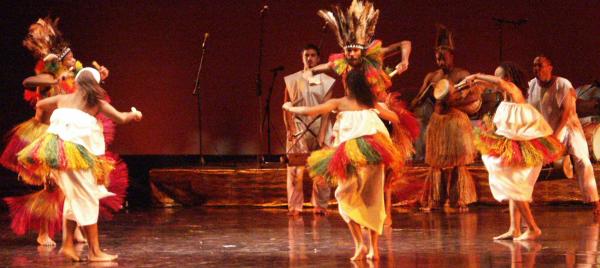
Ensemble is at once entertaining, enlightening and emboldening. Dramatic
staging, exciting rhythms, masterful choreography and colorful costumes
combine with consistently enthusiastic audiences to create an artistic
experience difficult to forget. But that is only the beginning. Nobody
sits through a performance by the Ensemble without learning from the
artists. Aspects of African Culture are explained and audience participation
in ritual is encouraged. The chants and rituals are all placed in
their proper historical contexts and everyone learns.
More importantly, though, learning takes place at another level and
enlightenment is not too strong a word to describe what actually takes
place. The dance itself becomes the means by which one comes to see
something of the human condition. Imprisonment, famine, poverty, drug
dependency, slavery and war can be juxtaposed with celebration of
liberation, bountiful harvests, marriage and birth in an artistic
blend that demands attention to the realities it represents. The art
has a message which not only condemns the worst and celebrates the
best of the human condition, it encourages us to do something about
the negatives and reinforces the positive. An audience leaves a concert
feeling at one with itself, the world and the dancers and musicians
who brought it all together.